

By Zakir, Sep 01, 2026
←Previous | SEO Series
Website-Level SEO Part 5 of 5
Step 5: Off-Page SEO
Introduction
So far, we have worked mainly on the website itself. Now we move outside the website.
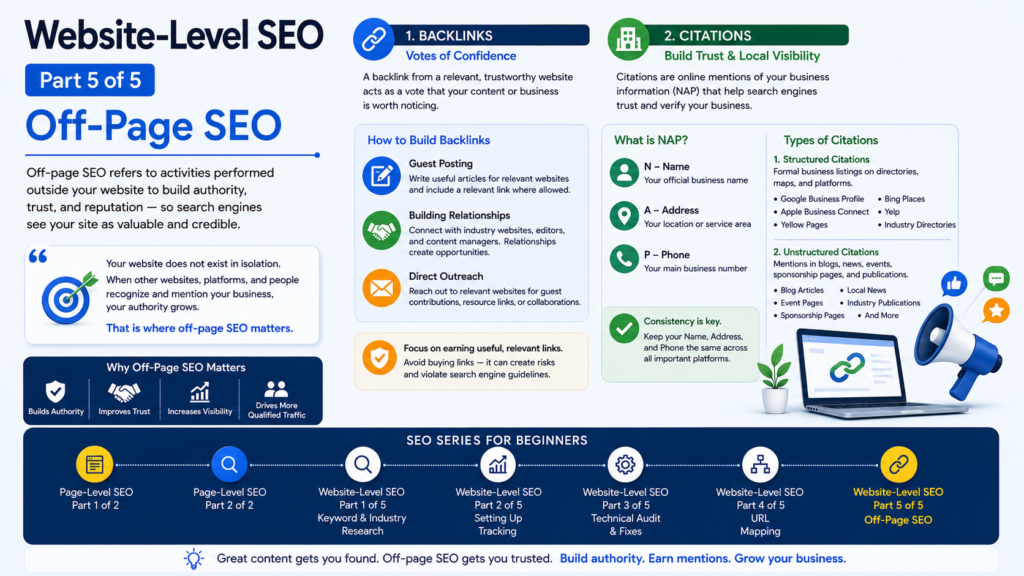
Off-page SEO refers to activities performed outside your own website to improve its visibility, authority, trust, and reputation.
Off-page SEO covers a wide range of activities, but in this beginner’s guide, we will focus on two important areas:
1. Backlinks
2. Citations
These two areas help us understand an important SEO principle:
Your website does not exist in isolation.
You can tell people that your website is excellent, useful, and trustworthy. But what happens when other websites, platforms, and people begin to recognize and mention it?
That is where off-page SEO becomes important.
Backlinks
What exactly does a backlink do?
You can think of a backlink as a kind of “vote of confidence” from another website.
I might claim that my website is excellent, but the more important question is:
What do others say about it?
When another relevant website links to your website, it can serve as a signal that your content or business is worth noticing.
However, not all backlinks are equally valuable. Relevance, quality, context, and the overall trustworthiness of the linking website matter.
So the goal is not simply to collect as many backlinks as possible.
The goal is to earn “useful and relevant backlinks”.
How can you build backlinks?
There are several ways to acquire backlinks.
Guest Posting:
You can write a useful article for another relevant website and, where the website’s editorial policy allows it, include a relevant link to your own website.
Building Relationships
You can identify websites related to your industry and gradually build professional relationships with their owners, editors, or content managers.
Over time, these relationships may create legitimate opportunities for collaboration, mentions, or links.
Direct Outreach
You can also contact relevant websites and ask whether they accept guest contributions, resource links, or other forms of collaboration.
The important point is to approach relevant websites with something genuinely useful to offer rather than simply asking for a link.
What about buying backlinks?
You may find agencies or vendors offering backlinks for money.
But buying backlinks simply to manipulate search rankings can create risks. The objective of off-page SEO should not be to purchase links indiscriminately.
Instead, focus on earning links through useful content, genuine relationships, relevant contributions, and legitimate business or editorial opportunities.
Where should you use a backlink?
A backlink should point to the page that is most useful for the visitor and most relevant to the context of the link.
For example, if a particular service page is difficult to improve through on-page optimization alone, earning relevant external recognition for that page may help strengthen its overall authority.
The important principle is:
Don’t build backlinks merely to increase a number. Build them to strengthen the right page and provide value to the right audience.
Citations
The second major area we will examine is citations.
A citation is an online mention of a business’s information, such as its name, address, and phone number (NAP). A citation may or may not contain a clickable link to the website.
Citations are especially important for local SEO because they help establish consistent information about a business across the web.
You can learn more about local citations here:
[INTERNAL LINK: Citation Guide / Google Docs]
What is NAP?
Citations commonly rely on NAP, which stands for:
N — Name (Your official business name)
A — Address (Your physical location or, where appropriate, your service area)
P — Phone (Your main business telephone number)
The key principle is consistency.
If a business presents different names, addresses, or phone numbers across important platforms, it can create confusion for users and search engines.
Types of Citations
Citations generally fall into two categories.
1. Structured Citations
These are formal business listings on directories, maps, and business platforms.
Examples include:
– Google Business Profile
– Apple Business Connect
– Bing Places for Business
– Yelp
– Yellow Pages
– Industry-specific directories
2. Unstructured Citations
These are informal mentions of a business within other online content.
For example, a business may be mentioned in:
– A blog article
– A local news story
– An event page
– A sponsorship page
– An industry publication
The information may appear naturally within the content rather than inside a formal business directory.
Why Do Citations Matter?
1. They Help Establish Consistency
When accurate business information appears consistently across relevant platforms, it creates a clearer and more reliable online presence.
2. They Support Local Visibility
For businesses that depend on local customers, accurate listings across important platforms can support local search visibility.
3. They Help Customers Find the Business
A citation is not only about search engines. Accurate business information helps real people find, contact, and recognize the business.
Where Should a Business Create Citations? A sensible approach is to begin with important platforms and directories relevant to the business.
A sensible approach is to begin with important platforms and directories relevant to the business.
| Directory Type | Platform | Why It Matters |
| Major Platforms| Google Business Profile |Important for Google Maps and local search visibility |
| Apple Business Connect | Important for Apple Maps and Apple services |
| Bing Places for Business | Supports visibility across Bing and Microsoft services |
| Major Directories| Yelp | A widely used business directory |
| Yellow Pages | A long-established business directory |
| Social / business platforms| Facebook / Meta | Can provide an additional business presence |
| Industry-specific| Relevant industry directories | Can provide context and visibility within a specific niche |
The exact platforms worth using depend on the country, industry, business type, and target audience.
There is no need to submit a business to every directory on the internet.
Focus on relevant, trustworthy, and useful platforms.
How to Find and Fix Inconsistent Citations
If a business has changed its phone number, address, or name, old information may remain online.
For example, one website may show the current phone number while another still displays the old one.
A practical citation cleanup process can look like this:
Step 1: Search for Old Information
Use Google to search for the business name together with old versions of its contact information.
For example:
“Your Business Name” + “old phone number”
or
“Your Business Name” + “old address”
Step 2: Create a Tracking Spreadsheet
Keep a master list of the websites where the business is mentioned.
Useful columns may include:
– Website name
– URL
– Current NAP information
– Incorrect information
– Correction status
– Notes
Step 3: Check Important Platforms First
Begin with the major business profiles and directories that matter most to the business.
Correcting the information on important platforms should be a priority before spending time on less significant listings.
Step 4: Update the Listings
Where you control the listing, log in and correct the information.
For other websites, contact the website owner or manager and request an update.
Step 5: Check Unstructured Mentions
Look for old information in blog posts, news articles, event pages, sponsorship pages, and other online mentions.
If the information is outdated, contact the publisher and request a correction where appropriate.
Step 6: Maintain Consistency
Keep the business information consistent across important platforms.
For example, if the official business information uses:
Suite 100, Main Street
avoid unnecessarily changing it to:
Ste 100, Main St.
when the difference could create ambiguity.
The goal is to maintain a clear and consistent representation of the business.
Backlinks and Citations: The Bigger Picture
Backlinks and citations serve different purposes, but both belong to the wider world of off-page SEO.
Backlinks primarily involve links from other websites to your website.
Citations establish and reinforce information about a business across relevant online platforms.
Neither should be treated as a numbers game.
The goal is to build a stronger and more trustworthy online presence.
For an SEO professional, this means asking questions such as:
– Which websites are relevant to this business?
– Which pages need external recognition?
– Which links would actually be useful?
– Where is the business already mentioned?
– Is its information accurate and consistent?
– Which relationships or opportunities can create genuine recognition?
– What should we improve next?
The Final Step
This is the fifth and final step of our SEO process:
Keyword and Industry Research
↓
Setting Up Tracking
↓
Technical Audit and Fixes
↓
URL Mapping
↓
Off-Page SEO
At this point, we have moved from discovering search opportunities to organizing keywords, checking technical health, mapping keywords to the right pages, and finally building recognition outside the website.
But this does not mean SEO is finished.
It means we now have a system that can be measured.
We can observe what happens after implementation, study the results, identify weaknesses, and improve the strategy.
And that leads us to the bigger question:
Does SEO actually help a business grow?
That is where our next journey begins.
Page-level SEO helps us improve individual pages.
Website-level SEO asks us to look at the entire business, the market, the website, the competition, the search demand, the customers, and ultimately the revenue.
That is the next mission.
The End of The Series: Page-Level vs Website-Level SEO