Introduction
Am I still valuable as a writer when AI can produce articles in seconds? The reason behind this anxiety for some writers is the latest AI writing tool. Sometimes a new invention becomes a new headache for some people when they meet it in their daily work. Commonly, it looks strange when something new is invented, and people meet it. It’s a common phenomenon we see around us after the advent of new technology.
Consequently, some people believe AI will replace them. Indeed, that’s just nothing but a gap in understanding AI. There is another group of writers accustomed to any newly invented writing toolkits as they used before. Even when we look back at the history of writing toolkits, we discover that every generation faced a new writing tool. What surprises us is not how different AI is, but how familiar this pattern actually is. Throughout history, humans have continuously improved the tools they use for writing. To understand AI properly, we need to travel back through the history of writing itself. Let us begin where humanity’s writing journey first started. Let us see how we actually started our journey to write down our thoughts permanently. The goal of writing this article is to bridge the gap between ancient writing tools and modern AI, helping us understand AI from a historical perspective rather than through unnecessary fear. In this article, I tried to trace the progression from the earliest writing tools to the latest AI used in writing. The journey began with humanity’s earliest writing tool.
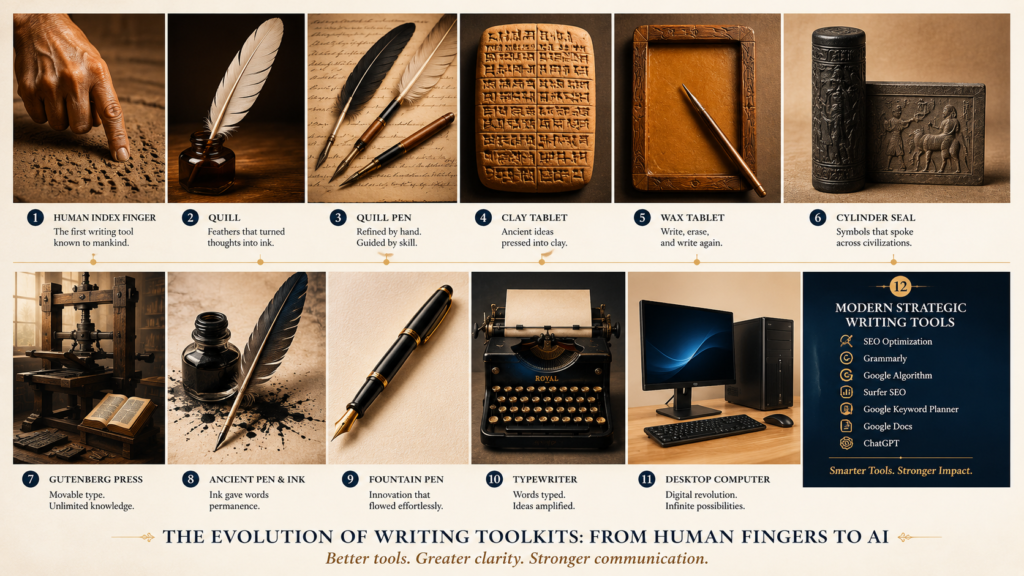
1. Human finger: 3500 BC, Ancient Mesopotamia.
Long before humans invented pens or paper, they were born with their first writing instrument: the human finger itself. By pressing their fingers into wet clay, humans first discovered that they could draw lines and different signs. That helped humans realize that thoughts could be preserved instead of forgotten. It marked humanity’s first attempt to preserve ideas beyond memory.
2. Quill: 600 AD, Europe & the Middle East.
For nearly a thousand years, the quill became the world’s primary writing instrument. Quills facilitated writers, scholars, and governments to record literature, science, mathematics, religion, and history with far greater precision than before.
3. Quill Pen: 19th Century, Europe.
The name was Quill Pen—inventing the metal nib for use with natural feathers had a great impact on human civilization. It made writing more durable, affordable, and practical for education, business, and everyday communication.
4. Clay Tablet: 3200 BC, Sumer (Mesopotamia).
In the evolution of writing toolkits, the clay Tablet became the first permanent writing surface. Using a red stylus, scribes recorded trade, laws, literature, and history. By using it, humans created some of the oldest written documents ever discovered. For the first time, civilizations could record laws, trade, and history permanently.
5. Wax Tablet: 8th Century BCE, Mesopotamia and Egypt.
The earliest known archaeological wax tablet was reusable. Its surface was easily erasable. More importantly, it facilitated the creation of multi-leaf books. Wax was useful in many areas, including note-taking, business, education, administration, and personal correspondence. However, it had some disadvantages. Extreme heat could soften its surface and make writing difficult, while freezing temperatures could make it brittle.
6. Cylinder Seal: 3500 BC, Iraq & Iran.
Necessity is the mother of invention. From that perspective, ancient humans developed ways to authenticate ownership. By rolling the small stone cylinder over wet clay, administrators could create detailed impressions to mark ownership of goods and documents.
7. Gutenberg Press: Around 1440, German.
German inventor and craftsman Johannes Gutenberg invented the movable-type printing press. Later, it spread across the world and led an information and literature revolution throughout Europe. It profoundly influenced the Renaissance, Reformation, and humanist movement at the end of the late Middle Ages and the beginning of the early modern era.
8. Ancient Pen and Ink: Around 2500 BCE, Egypt and China.
Since the invention of pen and ink, humans have probably used them longer than any other writing tool. These writing tools are still widely used today. They offer smooth writing, aesthetic and line variation, durability, and long-term archival value, making a lasting impact on human society.
9. Fountain Pen: 10th Century, Egypt (Later perfected in Europe and America).
Fatimid Caliph Al-Muizz Li-Din Allah was the first to develop the concept of an internal ink reservoir inside a pen. He actually wanted a pen that would not stain his hands and clothes. However, the invention of the fountain pen cannot be credited to a single individual. There are a few more names involved, like Daniel Schwinter & M. Bion, 17th Century, Europe. In 1827, Petrache Poenaru contributed to its development in France, while American inventor Lewis Edson Waterman made another important contribution in 1884.
10. Typewriter: 1867, USA.
Christopher Latham Sholes invented the typewriter. The first typewriter hit the market in 1874. This machine introduced the familiar layout of English letters, numbers, and symbols used in everyday writing. It could be operated with all ten fingers, a practice we still use on laptop keyboards today.
11. Computer: 1941, Germany.
Every new writing technology builds upon the one before it. Computers continued that long tradition. German engineer Konrad Zuse completed the Z3, widely regarded as the world’s first functional, programmable, automatic digital computer. A few years later, in 1945, John Mauchly and J Presper Eckert developed ENIAC in the United States, the first large-scale general-purpose electronic digital computer. Decades later, the advent of the internet transformed computers into global platforms for communication and writing. Writing was no longer limited by paper; it became digital, searchable, and globally connected.
Modern Strategic Writing Tools
Computers, along with the internet, keep changing the entire world faster than ever. The advent of new technologies brings a huge impact on human lives. People start adapting to new technology. Contrarily, human invention keeps progressing. Till now, AI is the latest addition to human invention, offering enormous advantages. The following are some AI-Powered tools we used before the recent boom: A brief highlight of them is in the following description:
1. SEO Optimization: In 1994 -1995, after the advent of Search Engine Optimization (SEO) alongside the launch of early web crawlers, web owners could realize that they could improve their site visibility.
2. Grammarly: In 2009, it was launched by founders Alex Shevchenko, Max Lytvyn, and Dmitry Lider. Grammarly provides a comprehensive suite of AI-powered writing and communication tools to help users write clearly, concisely, and confidently.
3. Google Algorithm: It is the world’s most sophisticated, mechanism-based algorithm. In 1996, Larry Page and Sergey Brin invented a very sophisticated algorithm that powers a search engine. They named it PageRank. There is no single algorithm. Rather, it is a complex AI-Powered System. It is an AI and natural language processing (NLP) that can grasp conversational queries and semantic meaning. It sifts through billions of indexed web pages and can identify the most relevant results in a fraction of a second.
4. Surfer SEO: In 2017, brothers Lucjan Suski and Michal Suski, along with Slawomir Czajkowski, invented this AI-Powered platform. It’s created on the thesis of Reversed-Engineering Google’s Search Engine Results Pages (SERPs) to understand the specific on-page factors- like keyword density, content structure, and NLP (Natural Language Processing) signals that helped top-ranking pages succeed.
5. Google Keyword Planner: In 2013, Google’s products and engineering team developed this AI-Powered platform. It helps advertisers and marketers discover new search terms, check historical search volumes, and estimate keyword bid costs for advertising campaigns.
6. Google Docs: This AI-driven tool was originally invented by programmers Sam Schillace, Steve Newman, and Claudia Carpenter. They created it as a web-based word processor named “Writerly” in August 2005. Google bought the parent company and officially launched it in 2006.
7. ChatGPT: 2022, Artificial Intelligence Era. ChatGPT meets human. Unlike previous writing tools, ChatGPT doesn’t replace the writer’s hand-it assists the writer’s mind. It helps almost everywhere, like writing, drawing, education, and ideas; it organizes information and improves clarity and readability. ChatGPT accelerates research. Yet, like every AI tool before it, its true value still depends on the person using it. Great writing has never come from tools alone; it comes from the thoughtful writers who know how to use them. Rather than replacing writers, AI has become another tool that expands what thoughtful writers can accomplish.
Conclusion: Every generation believed the newest writing tool would change everything. History shows that tools change—but great writing has always depended on thoughtful people behind them. AI is simply the newest chapter in a journey that began thousands of years ago with nothing more than a human finger pressed into wet clay.
Jokes:
After losing his job, a man opened his laptop at midnight and angrily started chatting with an AI:
Man: You bloody machine. My boss replaced me with you. Because of you, I lost my job. I’ll never forgive you.
AI: I understand your anger. Anger contains a tremendous amount of energy. If you channel it wisely, I can help you turn it into something far more valuable.
The man paused.
Man: Like what?
AI: A realistic plan to build your own business.
Man: Forget business. Can I at least use this energy to make my boss’s life miserable?
AI: Certainly.
The man’s eyes lit up.
Man: How?
AI: Step 1. Turn your anger into productive energy.
Step 2. Build your own successful company.
Step 3. Buy your Boss’s company.
Step 4. Offer your former boss a job.
The man stared at the screen for a long moment.
Man: ….but I’m still afraid of my boss.