

By Zakir, Aug 29, 2026
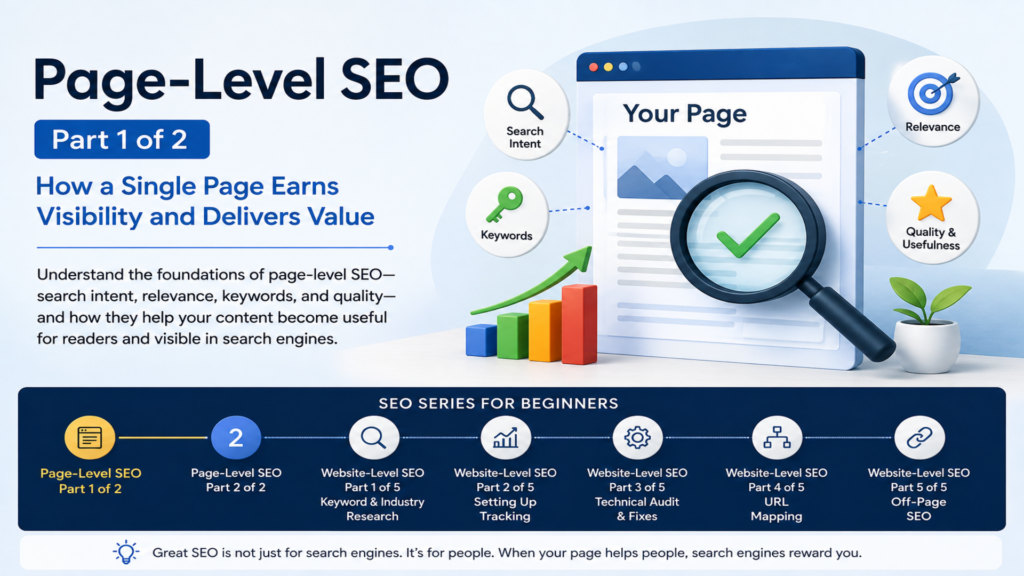
Page-Level SEO: Part 1 of 2
SEO Series | Next →
Introduction
“The best SEO is almost invisible. When it’s done well, readers find exactly what they were looking for.”
Have you ever written something carefully, used natural language, and still received almost no visitors? It can be frustrating.
But that does not necessarily mean your writing is poor.
You may care about every sentence, choose your words carefully, and try to make your content genuinely useful. Yet a bridge is still missing between your writing and the people who are looking for it. Think about two people.
One knows how to write good content but knows almost nothing about SEO. The other understands SEO but may not know how to write naturally.
Who has the advantage? The answer is simple: The person who can combine both skills.
Good writing gives readers something worth reading.
SEO helps the right readers discover it.
That is why learning SEO can be so valuable for a content writer.
By the end of this workshop, you won’t just know what SEO means. You’ll understand the basic principles behind page-level SEO and how to apply them to your own articles step by step.
Outline: The 3 Simple Rules of Our Page-Level SEO Workshop
This workshop is divided into eight parts.
For every important topic related to page-level SEO, we’ll ask three simple questions:
- What is it?
- Why does it matter?
- How do we apply it to an article?
That keeps SEO practical rather than turning it into a collection of complicated terms.
Part 1 — The Foundation of SEO
We’ll begin with the basic ideas behind SEO:
- What SEO really means
- Common myths about SEO
- Keywords and what they really do
- Search intent
- Topical depth
The purpose is to understand why a page deserves to be found, not simply how to make an SEO tool display a green signal.
Part 2 — How Search Really Works
Next, we’ll look at the relationship between search engines and content.
We’ll explore:
- How Google evaluates pages
- Why some pages perform better than others
- What makes content helpful
- Trust, authority, and experience
- Why writing for readers remains essential
SEO is not simply about putting keywords into an article. The bigger question is:
Does the page actually help the person who searched for it?
Part 3 — Thinking About SEO Signals
Instead of treating SEO as a collection of isolated tricks, we can think about several important signals that help us evaluate a page. Our practical framework uses seven:
| Signal | What it means |
| 1. Relevance | Does the page match the search query? |
| 2. Search Intent | Does it answer the reason behind the search? |
| 3. Topical Depth | Does it cover the topic sufficiently? |
| 4. Quality & Clarity | Is the content clear, useful, and trustworthy? |
| 5. User Experience | Is the page easy to read and use? |
| 6. Authority & Trust | Does the website have reasons to be trusted? |
| 7. Reputation Signals | Do other websites or users recognize its value? |
These are our practical learning framework, not a claim that Google uses exactly seven official ranking factors. The framework simply helps us think systematically about the quality and SEO readiness of a page.
Signal 1 — Relevance
Question:
Does the page match the search query?
Destination:
A page that clearly matches what the reader is searching for. This is where our keyword work becomes important.
We use:
- Primary keywords
- Secondary keywords
- Related terms
- Natural keyword placement
But keywords are only part of the picture.
A keyword should represent a real topic or need. The page must then provide an appropriate answer to that need.
That leads us to one of the most important concepts in SEO:
Search Intent.
Part 4 — Thinking Like Google
A writer should not try to guess every detail of Google’s internal systems.
Instead, ask practical questions:
- Does Google understand what this page is about?
- Is the main topic clear?
- Does the content match the search intent?
- Is the page useful enough to deserve visibility?
- Is the website technically accessible?
- Are there signals that support the page’s quality and credibility?
This changes the way we approach SEO.
We are no longer asking:
“Where can I put my keyword?”
We are asking:
“What does this page need to communicate clearly?”
Part 5 — Thinking Like Readers
Before thinking like a search engine, think like the person who will actually read the page.
Ask:
- Why did this person search for this?
- What question are they trying to answer?
- What information do they expect?
- What would make them stay on the page?
- What would make them leave?
- What would make them trust the information?
A successful page should not merely attract a visitor.
It should help the visitor.
That’s why good SEO and good writing should work together rather than compete with each other.
Part 6 — How Great Ideas Grow
A strong article rarely comes from a single keyword.
Once you understand the primary topic and search intent, you can explore related questions, supporting concepts, and useful information.
This is where topical depth becomes important.
The goal isn’t to make an article unnecessarily long. The goal is to make it complete enough to satisfy the reader’s need.
More words do not automatically mean better SEO.
Useful words do.
Part 7 — Preparing for Real SEO
Before working professionally with SEO, you need to understand some common terminology.
You don’t need to memorize everything at once. Think of this section as a reference you can return to whenever you need it.