

By Zakir, Aug 30, 2026
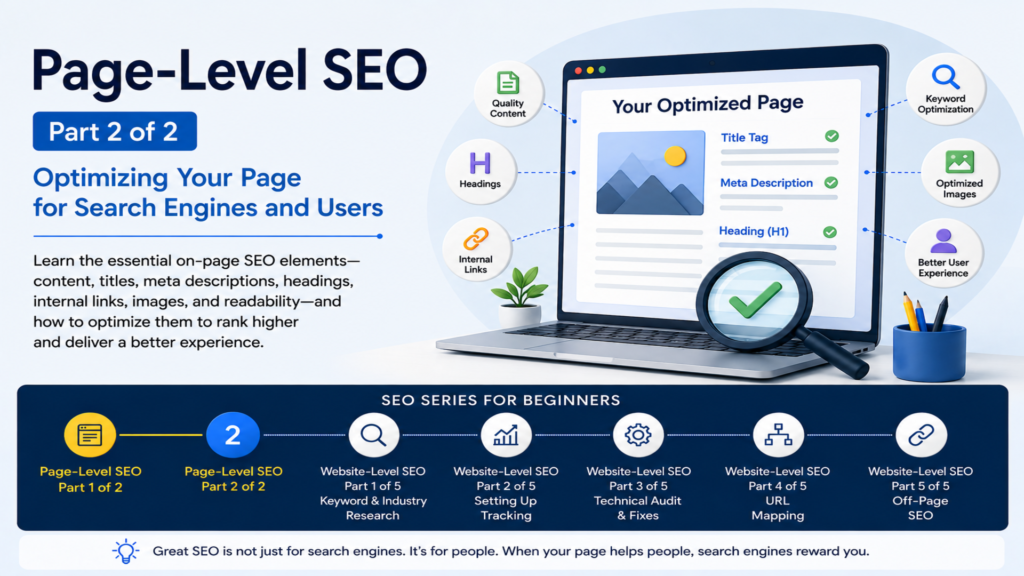
Page-Level SEO: Part 2 of 2
← Previous | SEO Series | Next →
Introduction
Before working professionally with SEO, you need to understand some common terminology in the SEO Glossary.
You do not need to memorize every term immediately. Instead, use this glossary as a practical reference while learning, writing, optimizing, and reviewing webpages.
Once these concepts become familiar, SEO instructions will feel less confusing—and you will be better prepared to understand how individual page improvements contribute to the performance of an entire website. But understanding these elements becomes much easier when we know the language SEO professionals use to describe them.
That is the purpose of this glossary.
The following terms are not random technical definitions. They are the essential building blocks of page-level SEO. They explain what search engines examine, what readers experience, and how an SEO professional evaluates the effectiveness of a webpage.
Primary Keyword
The primary keyword is the main search phrase an article is built around. It represents the primary topic you want the page to address.
Secondary Keywords
Secondary keywords are related words and phrases that naturally support the primary keyword. They help explain the topic more completely without repeating the same phrase unnecessarily.
Short-Tail Keywords
Short-tail keywords are broad search terms, usually one or two words long. They often have significant search demand but can also face strong competition.
Example: writing tips
Long-Tail Keywords
Long-tail keywords are longer and more specific search phrases. They often have clearer search intent.
Example: how to become a better writer for beginners
Search Intent
Search intent is the real purpose behind a person’s search—what they actually want to know, find, or accomplish.
Meta Title
The Meta title is the title that usually appears in Google’s search results. It gives readers and search engines a quick understanding of what the page is about.
Meta Description
The Meta description is a summary that may appear below the title in search results. It helps searchers decide whether a page is relevant enough to visit.
Backlinks
Backlinks are links from other websites to your website. They can contribute to the authority and reputation of a site.
On-Page SEO
On-page SEO involves optimizing elements within your webpage, including content, headings, keywords, images, internal links and page structure.
Off-Page SEO
Off-page SEO refers to activities outside your website that can improve its reputation and visibility, including earning backlinks, mentions and recognition from other websites.
Organic Traffic
Organic traffic consists of visitors who arrive through unpaid search engine results rather than advertisements.
Target Domain
A target domain is a website you may want to earn a backlink from or build a relationship with because it is relevant to your topic or industry.
Domain Authority (DA)
Domain Authority is a third-party metric created by SEO tools to estimate the relative strength of a website.
Important: Domain Authority is not a Google ranking factor. It is an industry metric that can be used as a comparative reference.
Linking Domain (Referring Domain)
A linking domain is a unique website that links to your website. Whether it provides one link or several, it remains one linking domain.
Inbound Link
An inbound link is a link from another website to your website.
Inbound links are another name for backlinks.
Internal Link
An internal link connects one page of your website to another page on the same website.
Internal links help visitors navigate your content and can also help search engines understand the relationship between pages.
External Link (Outbound Link)
An external link is a link from your website to another website.
When you refer readers to a useful and reliable external source, you are creating an outbound link.
SERP
SERP stands for Search Engine Results Page—the page of results displayed after someone performs a search.
Crawler / Googlebot
A crawler is an automated program that discovers and accesses webpages.
Googlebot is Google’s crawler.
Indexing
Indexing is Google’s process of understanding and storing information about webpages so that they can potentially appear in search results.
Ranking
Ranking refers to the position a webpage occupies in search results for a particular query.
A page may rank differently for different searches.
Part 8 — The Journey of a Webpage
A webpage doesn’t simply jump from being published to becoming successful in search.
We can think about its journey in stages:
Discovery→ Crawling→ Indexing→ Evaluation→ Ranking→ Re-evaluation
This is a useful way to understand why SEO is not a one-time activity.
After a page is published and indexed, its performance can still change.
Competitors publish better content.
Search behavior changes.
The page itself may need improvement.
The business may develop new priorities.
Therefore, SEO requires observation and continuous improvement.
The Principles of Page-Level SEO
Now let’s bring everything together.
Part I — Search Intent
- SEO begins with understanding search intent rather than stuffing keywords.
- Find the question before you write the answer.
- Make sure the page actually satisfies the searcher’s purpose.
Part II — Keywords
- Choose an appropriate primary keyword.
- Use related keywords naturally.
- Don’t force a keyword into every paragraph.
- Let the topic guide the language.
Part III — Titles
- The SEO title helps earn the click.
- The article must then reward that click.
- A title should accurately represent what the reader will find on the page.
Part IV — Content
- Research ranking pages to understand the existing conversation—not to copy their words.
- Cover the topic sufficiently.
- Write clearly and naturally.
- Prioritize usefulness over unnecessary length.
- Helpful content is more valuable than short-term tricks.
Part V — Readers
- Write for people first.
- Make the page easy to understand.
- Give readers a reason to continue.
- Help them accomplish what they came to do.
So, What Should You Remember About Page-Level SEO?
You don’t need to memorize hundreds of SEO rules, but remember only the basic chain:
Search Query → Search Intent → Relevant Topic → Useful Content →
Good User Experience → Trust & Supporting Signals → A Page Worth Finding.
That is the foundation of page-level SEO. SEO does not replace good writing. It helps good writing find the people who need it. And when a writer can combine writing skill + SEO knowledge, something much more powerful becomes possible. You are no longer simply writing an article. You are building a bridge between a searcher and the answer they need.
End of Page-Level SEO