

By Zakir, Jun 30, 2026
Introduction
When looking closely at massive market leaders, there is often one silent feature behind the billion-dollar businesses that drives their growth from the shadows.s. A writer can be a game changer when the right words transform how customers think, trust, and buy. Every year, thousands of companies are launched around the world. Some grow into industry leaders, while many remain trapped in narrow earnings or quietly disappear.
Surprisingly, the difference isn’t always a better product, more technology, or a larger marketing budget. Sometimes, the real difference comes down to the power of copywriting in business—a silent force capable of transforming how customers think, trust, and buy. A truly skilled writer can become the architect behind a company’s transformation, helping turn modest earnings into extraordinary success.
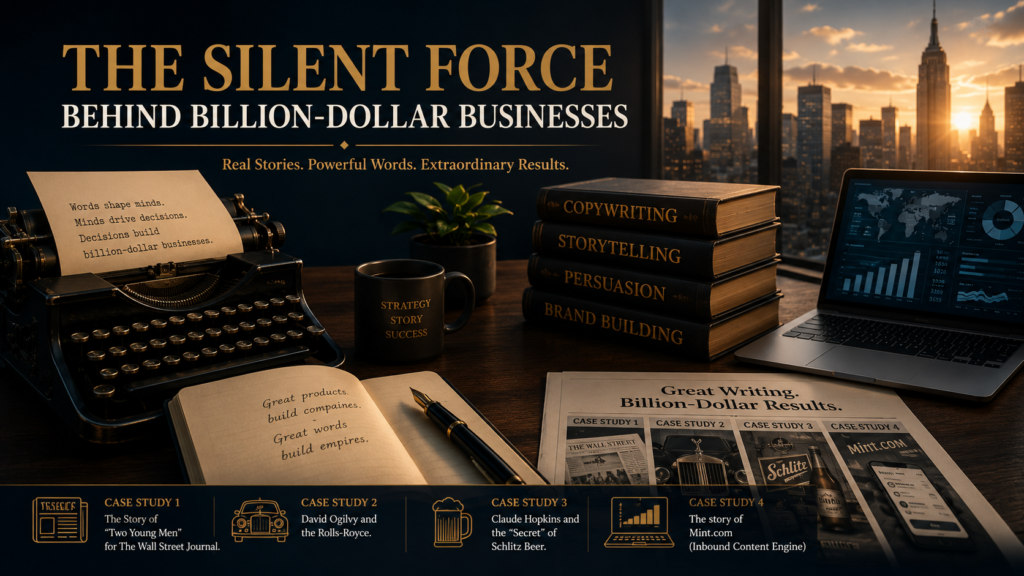
The following famous copywriting examples show how strategic writing has generated billions of dollars, transformed global brands, and reshaped entire businesses.
Case Study1: The Story of “Two Young Men” for The Wall Street Journal
The Background:
Back in 1975, a copywriter named Martin Conroy wrote a sales letter for The Wall Street Journal.
The Plot:
The letter told the simple story of two young men who graduated from the same college. Both were better than average, personable, and full of big dreams. Twenty-five years later, they returned to their college reunion. Both worked for the same company. But one was a mid-level manager, while the other was the president of the company. The difference? The president read The Wall Street Journal.
The Financial Impact:
Incredibly, that single piece of writing ran for 28 years (until 2003) and generated over $2 billion in subscriptions. A writer quite literally helped transform that publishing company into a vast empire through a simple two-page story.
Case Study 2: David Ogilvy and Rolls-Royce
The Background:
In 1958, a writer named David Ogilvy was tasked with writing an ad for Rolls-Royce, a premium brand struggling to capture the American market.
The Plot:
Ogilvy spent three weeks reading every technical detail about the car until he found one line to write about it.
Finally, he wrote the headline:
“At 60 miles an hour the loudest noise in this new Rolls-Royce comes from the electric clock.”
The Financial Impact:
Incredibly, the ad was a remarkable success. The following year, Rolls-Royce sales increased by 50%, forcing the factory to create a waiting list.
The “silent power” of David Ogilvy’s pen transformed a luxury car from a mere symbol of prestige into an engineering marvel. Consequently, customers rushed to own the vehicle.
Case Study 3: Claude Hopkins and the “secret” of Schlitz Beer
The Background:
In the early 1900s, Schlitz Beer was struggling, ranking between fifth and eighth in the market. They hired a legendary copywriter, Claude Hopkins, to help them scale.
The Plot:
Hopkins knew nothing about the beer-making process. So, he went to the Schlitz factory.
During the tour, Hopkins was amazed by the extraordinary care taken during production: artesian wells supplied pure water, filtered air protected the beer during cooling, and every bottle was sterilized with live steam.
Hopkins turned to the factory owner and asked, “Oh my god, why don’t you tell people this in your advertising?”
The factory owner shrugged and replied, “Because every beer company does this as a part of just the standard process of making beer.”
The Game-Changing Move:
Hopkins realized that while the industry knew it, the public had no idea. They were just shouting, “Our beer is pure!” without explaining why.
Hopkins then created a series of ads packed with detailed, educational content that explained the cleaning process, including artisan wells, purified air, and live steam. Yet he didn’t utter a single falsehood; he only highlighted aspects that no one else had ever thought necessary to explain.
Financial Impact:
By simply being the first to describe the process, Schlitz claimed ownership of the concept of “purity” in the consumer’s mind. Within a few months, Schlitz rose from fifth place to the top of America’s beer market.
Sometimes, a move that clearly highlights what a company actually does can be a game changer. Indeed, a skilled writer knows how to tell a company’s story in a way that customers remember.
Case Study 4: Mint.com & The Silent Feature Behind Billion-Dollar Businesses
The Background:
The founders didn’t go for Google banners or TV ads. They hired writers to develop a blog named MintLife—a classic example of how content drives business growth.
The Plot:
Now, let’s dive into the digital age. In 2006, a brand-new personal finance app named mint.com was preparing to launch. They had no brand awareness, very little marketing budget, and the product wasn’t even fully coded yet.
The Financial Result:
The writers didn’t write monotonous corporate updates. They just kept researching to understand what exactly the young professionals were struggling with. Finally, they wrote some incredibly valuable and easy-to-read content for the blog.
They published:
- Detailed how-to guides on paying off college debt.
- Creative breakdowns of ways to save for a down payment on a house.
- Fun, engaging weekly series like “Trainwreck Tuesday” which looked at hilarious or shocking real-life financial disasters.
They hyper-focused on high-intent SEO terms and seeded their articles on social sharing sites like Reddit and Digg. They made complex finance feel accessible, trustworthy, and modern.
The Bottom Line: Writing Can Become a Business Game-Changer
A company can have a revolutionary product, but without the words to make the world care, it will remain trapped in narrow earnings. This is why a writer can sometimes become the real game changer. A masterful writer doesn’t just fill pages with text; they build the psychological infrastructure that drives commerce. This is what copywriting psychology is. A writer acts as a medium for transforming unfamiliar customers into brand advocates. This is why a writer is considered a game-changer capable of skillfully elevating a company from the ordinary to the extraordinary. And if you are interested or like to know more about Trade Secret, click here.
A Little Joke: It Reminds the Silent Feature Behind Billion-Dollar Businesses
After reading the case studies in this article, a company owner quickly hired a writer.
The writer visited the factory with the owner, and at the end of the tour, the writer asked the owner, “You should have hired me earlier.”
The owner asked, “Why?”
The writer explained, “In that case, I probably could have become rich now.”
The owner then asked, “How?”
The writer replied confidently, I know how to transform a company into Zero-to-Hero or Hero-to-Zero as well. So, I should have made a deal with you for 2 years instead of 1. In the first year, I would transform your company into a “Zero-to-Hero” success. Then I’d ask to buy a 50% stake in your company.
The owner then asked, “Have you ever bought 50% of a company before?” The writer smiled and replied, “No, just now, the idea landed in my mind.”