

By Zakir, Sep 29, 2026
Introduction
It keeps fascinating me how deeply a keyword is connected to search intent. As an SEO specialist, understanding the intent behind the right keywords helps people accomplish their goals smoothly. Connecting keywords to search intent ultimately improves search visibility and can contribute to business growth and revenue.
Anyway, let’s cut to the chase and understand what search intent really is.
1. What on Earth Is Search Intent?
Search: The literal words a person types into a search engine.
Intent: The underlying problem, question, or goal they are trying to solve.
Put them together, and search intent is the “why” behind a search. It reflects the mindset, needs, and goal of the person sitting behind the screen.
When you understand search intent, you stop guessing what to write. You stop throwing random words at your website and hoping something sticks. Instead, you learn to understand what the searcher is actually trying to accomplish.
For an SEO writer, showing a client that you understand search intent is a powerful way to demonstrate professional expertise. For a business owner—whether running a bakery, food-delivery company, or local plumbing service—aligning a website with search intent can make the difference between a page that attracts visitors and one that turns relevant visitors into customers.
2. What Is Search Intent?
Search intent is the underlying goal or purpose behind a search query—the specific information, solution, product, or action a user expects to find.
It acts as a bridge between a user’s problem and your content’s solution.
Search intent isn’t just about what people type. It’s about what they actually want to accomplish.
3. Comparative Picture: Search Intent vs. Keywords
Fundamentally, keywords and search intent are different from each other:
- Keywords are the specific words or phrases that users type into a search engine such as Google or YouTube.
- Search intent is the underlying reason, goal, or purpose that motivates the user to perform that search.
Keywords get people to your front door; search intent determines whether they find what they came for.
That distinction matters because ranking for a keyword is only part of the job. If the page does not satisfy the reason behind the search, visibility alone may not produce meaningful results.
4. Why Is Search Intent Important in SEO?
Search intent acts like a gravitational force in SEO. Keywords can increase search visibility, but search intent helps determine whether that visibility leads to meaningful engagement, useful actions, and potential business results.
When you analyze a group of related keywords, you can begin to understand how people think about specific problems and what they expect to find.
Knowing SEO at both the page level and website level, combined with strong writing skills, makes a significant difference.
As an SEO writer, you develop an instinct for the human mindset behind a keyword. At the same time, business owners know their customers firsthand—how they judge service quality, why they return products, what makes them hesitate, and why they come back to buy again.
These real-world behaviors provide valuable clues about search intent.
5. Types of Search Intent: The Four Pillars
5.1 Informational Intent
The user wants to learn, find an answer, or discover information before making a decision.
Examples:
- “How to change a tire”
- “What is SEO?”
- “How to cook rice in a rice cooker”
5.2 Commercial Investigation
The user is researching options and comparing products, services, or solutions before deciding what to choose.
Examples:
- “Best hiking boots for wide feet”
- “Best bicycle brands”
- “X vs. Y SEO tools”
- “Top smartphones under $100”
5.3 Transactional Intent
The user is ready to take action, often by purchasing a product, booking a service, placing an order, or contacting a business.
Examples:
- “Order Galaxy S25 Ultra”
- “Buy iPhone 17 online”
- “24/7 plumber near me”
These users generally benefit from pages that make the desired action clear and easy.
6.3.1 The “Best” Trap: Why One Word Can Change Everything
The user wants to reach a specific website, page, or digital destination, often using a search engine as a shortcut.
Examples:
- “Twitter login”
- “ZakTheWriter”
- “Amazon customer support”
6. How to Identify Keywords and Topics Based on Search Intent
6.1 Investigate the SERP
One of the fastest ways to understand how a search engine interprets a query is to examine the current search results.
If the first page is dominated by detailed guides and informational articles, that is a strong signal that the query has informational intent.
If the results are dominated by product pages, comparison pages, category pages, or service pages, the query may indicate commercial or transactional intent.
The SERP provides evidence of what type of content is currently satisfying that query.
6.2 Target Specific Audience Goals, Not Broad Reach
Focus on the audience’s mindset rather than trying to reach everyone.
For example, a user searching “cancel Spotify subscription” and another searching “how to close Spotify account” may have essentially the same goal.
Rather than creating separate content for every slight variation, you can often group closely related queries around one underlying search intent and create a stronger content asset.
6.3 The Secret to Winning Customers: Match Their Mindset
6.3.1 The “Best” Trap: Why One Word Can Change Everything
When a customer types “best” into Google—such as “best bakery near me” or “best plumbing service”—it is easy to assume they are ready to buy immediately.
But they may not be.
Their mindset is usually focused on investigation. They may already have a need, but they are still deciding whom to trust.
To the customer, “best” can effectively mean:
“Help me filter out the bad options. Who can I trust?”
Sending these searchers directly to a poorly structured checkout page may create unnecessary friction. They may first want reviews, testimonials, comparisons, credentials, pricing information, or other forms of proof.
The page should therefore help them evaluate their options before asking them to commit.
6.3.2 The Real “Ready to Buy” Mindset
To identify searchers who are closer to taking action, look for words and phrases that indicate immediate intent.
“Order” or “Buy” — for example, “order gluten-free pizza delivery.”
The searcher is probably looking for a straightforward path to purchase. They may want the menu, product information, availability, and checkout rather than a long educational article.
“Near me” or “Close by” — for example, “emergency plumber near me.”
The searcher may have an immediate problem and be looking for a local business that can respond quickly.
“Price” or “Rates” — for example, “catering price sheet.”
The searcher may already understand the service and simply want to determine whether it fits their budget.
The important lesson is that the words surrounding a keyword can reveal the searcher’s stage in the decision-making process.
6.3.3 The Storefront Metaphor
Imagine a customer walking into your business.
If they rush in saying, “I need a birthday cake right now!”, you don’t hand them a 10-page recipe book. You point them toward the display case, help them choose, and make the purchasing process easy.
But if they walk in and ask, “What’s the difference between buttercream and fondant?”, you don’t immediately say, “Your total comes to $35.”
You explain the options and help them make a confident choice.
The same principle applies online.
The page should match the customer’s mindset.
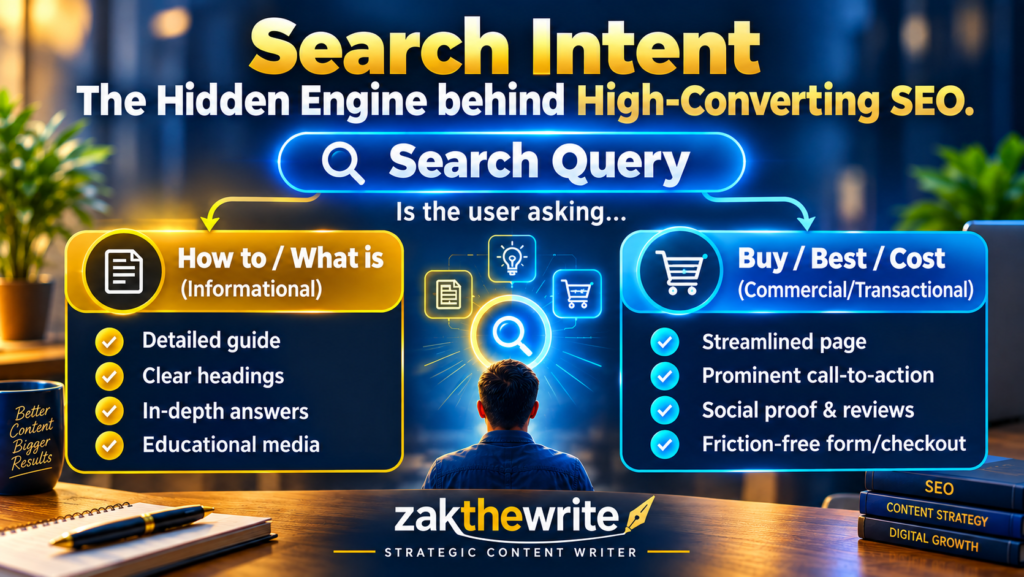
7. Match Your Website Layout to the Customer’s Mindset
The “Ready to Buy” Customer — Transactional Queries
Give them a streamlined landing or service page.
Keep it focused, remove unnecessary distractions, and make the desired action obvious with calls to action such as:
- Order Now
- Book an Appointment
- Call Us
- Get a Quote
The “Shopping Around” Customer — Commercial Queries
Give them a structured, easy-to-read comparison guide, review page, or buying guide that helps them evaluate their options.
Useful elements may include:
- Clear comparisons
- Reviews and testimonials
- Pricing information
- Product or service benefits
- Social proof
- A clear next step
The goal is not simply to rank the page.
The goal is to give the searcher the experience they were actually looking for.
8. Systems-Driven SEO That Drives Growth
Human-Centric Keyword Analysis
Grouping related keywords reveals how target audiences think, search, compare, and make decisions.
Systems Mindset
Understanding organizational and human behavior can help an SEO writer look beyond individual keywords and recognize the broader patterns behind search behavior.
Data-Driven Strategy
Effective SEO requires structured research, audits, keyword mapping, internal linking, content planning, monitoring, and systematic improvement.
Practical Application
At ZakTheWriter.com, I apply these principles as part of a broader SEO workflow designed to connect searcher needs, content strategy, and business objectives.
The objective is not simply to attract traffic.
It is to attract the right people with the right page at the right stage of their journey.
Conclusion
Search intent is one of the foundations of effective SEO because it forces us to look beyond keywords and understand the person behind the search.
A keyword tells us what someone typed.
Search intent helps us understand why they typed it.
Once you understand that difference, your content decisions become clearer. You can choose the appropriate page type, structure the information around the searcher’s needs, select relevant calls to action, and create a smoother path from search to solution.
For an SEO writer, this means moving beyond keyword placement and thinking like the person searching.
For a business owner, it means building pages that meet customers where they are—whether they are learning, comparing, or ready to act.
Understand the search. Understand the intent. Then build the page around the person.