

By Zakir, Aug 30, 2026
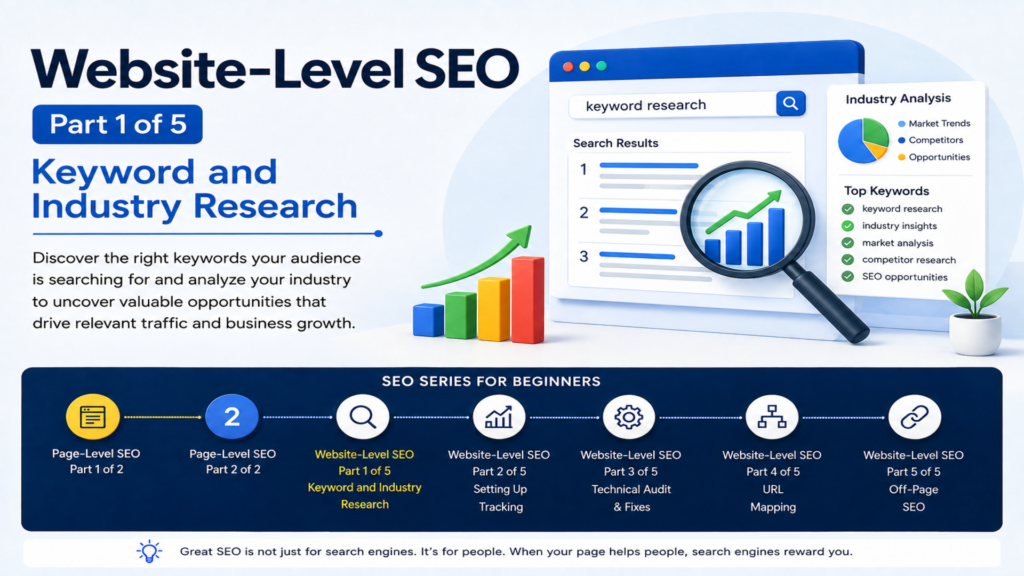
Web-Level SEO: Part 1 of 5
← Previous | SEO Series | Next →
Step One: Keyword and Industry Analysis
Introduction
I worked my ass off to understand SEO—not just as a collection of techniques, but as a skill that can influence a company’s revenue. It took me only a few days to get a practical understanding of page-level SEO. Then I spent about a week researching website-level SEO and, more importantly, how SEO can influence a company’s revenue.
That discovery surprised me. If SEO can influence something as important as a company’s revenue, doesn’t that make you want to understand it more deeply? For me, it did. And that curiosity is exactly what keeps us learning—and, over time, can turn a beginner into an expert. An experienced learner is sitting beside me and telling me how he discovered this. So I want you to learn the same step by step, following a series of 5 steps.
The purpose of this SEO series is to help beginners. Each part is written separately, so you can follow the series comfortably, one step at a time. I hope it will give you the confidence to develop SEO as a skill and eventually use it to offer services to clients globally. You only need the interest to learn. Benjamin Franklin once said, “Curiosity is the wick in the candle of learning.” So, your level of interest matters most. It’s a fact: “When interest touches the sky, learning becomes effortless, and consistency becomes a habit.”
This SEO series are divided into 5 steps:
1. Keyword and Industry Research
2. Setting Up Tracking
3. Technical Audit and Fixes
4. URL Mapping
5. Off-Page SEO
So, let’s dive into the first step.
Keyword and Industry Research
Keyword and industry research basically focuses on creating a bridge between the buyer and the seller. An SEO professional builds that bridge through research and analysis of the words and phrases potential customers may use when searching for a product or service.
A market analyst—or even someone with good marketing sense—can make an educated guess about what people might type into Google when looking for something. But the job of an SEO professional goes further. The goal is to use research to discover and validate the searches that can increase a company’s visibility and connect it with potential customers.
Imagine a dentist comes to you and says, “I want to expand my business. Since you are an SEO expert, here is my website. I want you to improve its SEO so that more people can find my dental clinic in Gazipur.”
SEO is one of the marketing channels within digital marketing, alongside channels such as Facebook and TikTok advertising. So, one of your first responsibilities is to determine whether SEO is a good marketing fit for this particular business.
How do you determine whether SEO is a good marketing fit?
Start with your marketing sense and experience. Ask yourself: How do people in Dhaka search for a dentist? What would they type into Google if they needed dental treatment?
Try to understand the answers to those questions. If your research suggests that very few people are using Google to look for the service, SEO may not be the most effective marketing strategy for that business. Rather, a Facebook ad might be a good fit for it.
But if SEO appears to be a good fit, what should you do first?
Collect keywords for SEO from 3 stages:
1) Use common sense and your marketing brain
2) Use free SEO research tools
3) Keywords through Competitor Research
One: Use Free SEO Research Tools.
Use common sense and your marketing brain.
This is the beginning of the bridge you are going to build. You are making a list of words and phrases that potential customers might type into Google when looking for the product or service, for answer they need.
People use these search queries to find what they need. The reason behind a particular search—the goal the searcher is actually trying to accomplish—is called search intent in SEO.
Your first list might contain approximately 50 or 60 targeted keywords. You can then use some free research tools to find a few more keywords.
Two: Use Free SEO Research Tools.
How do we do it?
Since you can already make an educated guess about what people may type into Google, you can now begin testing those assumptions.
And then your tool experiment can follow.
Remember that the keyword tool doesn’t create the SEO professional’s thinking.
The professional first has a hypothesis about the market and customer.
Then the tool helps investigate that. That fits beautifully with the professional mission we’ve been building:
Market demand→ Search demand → Search intent → SEO strategy →Right pages/content→ Qualified visitors → Conversions → Revenue.
The real lesson is how an SEO professional thinks before and during keyword research.
You already know that people want to find the answer to a particular issue through keywords. This is called search intent in SEO.
Using a free keyword search tool, consider a few more keywords, suppose 40 to 50 +:
Three: Keywords through Competitor Research
How do we do that?
Who are our competitors? Whenever you type a keyword—for example, “SEO service”—or any other keyword from your initial list into the Google search field, Google displays several websites in the search results.
These websites can be considered your SEO competitors because they are already appearing in the search results for the keyword you are researching.
How do we research and discover our competitors’ keywords?
Step 1: Choose a competitor
Click on any company or website ranking near the top of the search results—perhaps in positions 1, 2, or 3, or another result that you consider relevant.
Copy the domain name of that website from your browser and paste it into the appropriate search field of an SEO research tool.
For example, you can use RyRob. Go to Free Tools in the navigation bar and select Free Keyword Tool. Then scroll down to the SEO Tools section and select Keyword Research Tool. Enter the domain or keyword as required by the tool and click Submit.
The important thing is that the tool can help you discover keywords associated with the website you are researching. Some tools can also identify existing SEO issues and provide suggestions for fixing them.
Step 2: Try another competitor if necessary
From my experience, a free SEO tool may sometimes fail to accept a particular website or domain for an audit. We don’t need to spend our time trying to figure out why.
Simply leave that one and try another relevant competitor’s domain.
That’s what I did. When the first domain didn’t work, I entered another one, and the tool accepted it.
You can also use the tool named Wordtracker: It’s a very useful tool.
Select the appropriate option from its navigation or search interface, enter the competitor’s domain when the tool allows domain research, and run the search. Depending on the tool and the
Information available, you may be able to discover keywords associated with the website and identify opportunities worth investigating further.
From the results, extract the keywords that are relevant to your own business and worth researching further.
You can also try the free tool WordStream.
Or, you can go to the website, select Free Tools, and then choose Free Keyword Tool. Follow the instructions provided by the tool and enter the required information into the search field.
The purpose of using these tools is to discover additional search opportunities that we may have missed when creating our initial keyword list.
That gives us another important source of information: what people are already searching for and what competing websites are already being found for.
One important improvement you need to know:
“Use the tool, and you’ll get all the keywords.”
For the professional SEO mindset, I sometimes try to say that searching for the most relevant keywords is too simplistic.
But the better lesson is:
Competitor research → discover possibilities → extract relevant keywords → investigate them → decide which opportunities matter.
That keeps the article aligned with the much bigger mission you’re learning.
And there’s a particularly nice progression now:
Our own marketing sense → Initial keyword hypotheses → SEO tools→ Google SERPs→
Competitors→ Competitors’ keyword opportunities
That’s beginning to feel like an actual SEO investigation, rather than a tutorial about clicking buttons.
Now the next stage: What Do We Do with All These Keywords?
Using these three stages: Common sense, Free SEO tools, and Competitor research —I eventually discovered 164 potential keywords. But 164 don’t mean 164 keywords must be used on my website. Keyword research gives me possibilities; judgment determines which ones deserve a place.
Some will land on some existing pages. Some may require a new article or page. Some may be useful only after further research. And some will even be rejected. The keyword list can also grow later as new opportunities appear.
Finally, use a Google Sheet for the keyword list, and then write an email to your client, for example-
Subject: Please Review the Initial Target Keyword List
Dear Sir,
Please find attached the draft of our initially targeted keywords based on our keyword and industry research.
Please review the list and let me know which keywords you consider suitable and which ones you would prefer not to target. You are also welcome to suggest any important keywords, products, services, or terms that you feel are missing from the list.
Your feedback is very important because you know your business, products, services, and customers better than anyone outside the company. You also know the language your customers commonly use when they discuss their needs and search for solutions.
After receiving your feedback, we will carefully reanalyze the suggested keywords and compare them with our existing research. This process may reveal additional opportunities that we could not identify from external research alone.
We may go back & forth a few times to refine the list and make sure the selected keywords can reflect your business and its customers.
Thank you for your valuable input. I look forward to your feedback.
Best regards,
ZAK The Writer